
n recent times, there has been a boom of cooking stoves touted to use less firewood for cooking and heating on the market.
Ironically, while these stoves are meant to be energy-efficient, trees are used in the production of most of them.
Noting the contradiction, Development Aid from People to People (Dapp), through its farmers’ clubs, is teaching communities in Chiradzulu and Thyolo districts how to construct firewood saving stoves that do not require burning of trees in their production.
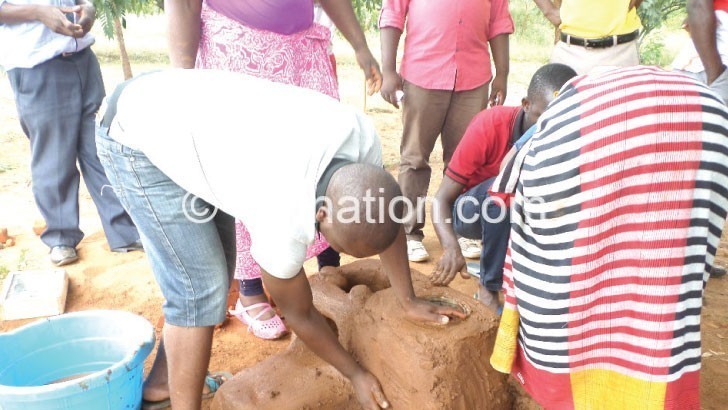
Shernard Ellias, farmers’ club project leader for Dapp Macadamia in Thyolo, says the stoves are meant to promote sustainable use of biomass energy by halving pressure on forests.
“For other energy-efficient stoves, more trees have to be burnt to make them. That is not the case with the firewood-saving stoves we are making. These are constructed using locally available resources,” he said.
Ellias said the stove, hyped for promoting health and hygiene by emitting less smoke, is durable than the mobile ones.
“Every household needs this stove in its kitchen. Demand for biomass energy is high with persistent power outages so we have to use it sustainably,” he said.
Dapp, which runs teacher training colleges (TTCs) in Blantyre, Thyolo, Dowa and Mzimba, has engaged its graduate teachers under Dapp 400 Primary School Programme to expand the stove construction capacity among Malawians.
Through pupils, 78 of these teachers found in 69 public primary schools across 18 districts champion girl child education, climate change and global warming, sanitation, and community health.
Recently, during the programme’s production camp at Dapp Chilangoma TTC in Blantyre, 40 teachers were drilled in construction of the stove in order to impart the skill in respective societies through pupils.
Materials required to erect the stove, which is ready for use in seven days after completion, include seven small bricks, 20 kilogrammes (kg) of anthill or clay soil, 10 kg of river sand, 1.2 kg of ash, a five-litre tin and water.
The construction process involves laying the bricks in four, two, one formation; soaking the soil and mixing thoroughly with river sand to produce good mortar.
Then, the five-litre tin is dipped in water and put among the four bricks. The whole tin and bricks are covered with mortar and a firewood door is opened by cutting 10-12 centimetres wide and 15-17 centimetres long on one side of the stove before letting it dry.
One of the facilitators during the camp, Dapp Chiradzulu Farmers’ Club project leader, Sella Ngwira, said usage of the stove will nurture environmental-conscious mindset among communities.
“This is one way of conserving the environment and protecting trees being planted because we will not cut them at large-scale for energy,” she said.
In an interview, the programme coordinator Jimmy Kayange said the programme teaches the eco-friendly attitude in pupils to help societies and next generations win the fight against deforestation.
“We depend on biomass energy, but people’s laxity to reafforestation drives has resulted into environmental degradation. Now, we experience chronic hunger because effects of climate change affect our crop yields,” he said.
Kayange added that the stove will directly address societal challenges women and children face in communities.
“They will no longer walk long distances to fetch wood because the stove needs less firewood. Unlike the three stone fire, this promotes health as it emits less smoke. Every teacher is expected to assist 200 households erect the improved cooking structure,” he said.
One of the teachers at the camp, Justin Kamiza of Gungulu Primary School in Chikwawa, said communities will embrace the stove as they are eager to conserve the environment.
“The effects of climate change have made it easy for everyone to realise importance of trees. This stove will complement their intensified efforts of reafforestation,” he said.
Apart from planting over 2 500 trees in their respective schools this year, the targeted pupils have been challenged to make sure every tree survives. The pupils are also expected to reach out to 2 000 households with the capacity to construct the stove.
The teachers came from Kasungu, Dowa, Ntchisi, Lilongwe, Dedza, Ntcheu, Balaka, Machinga, Mangochi, Neno, Blantyre and Chiradzulu, among others.
Source: The Nation_Monday, 28 February 2022, By Temwa Mhone_Correspondent