
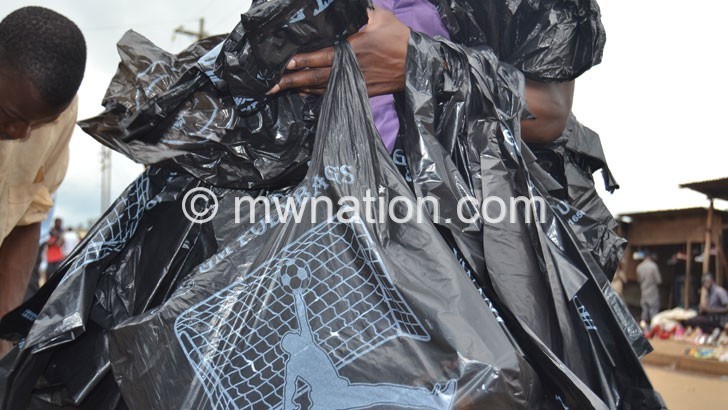
Movement for Environmental Action in Malawi says it is not amused with the slow pace in enforcing the nationwide ban on thin plastics.
Single-use plastics are widely seen on sale a year after the Malawi Supreme Court of Appeal overturned manufacturers objection to the environmental management order announced in 2015.
Dorothy Tembo-Nhlema, head of programmes at Lilongwe Wildlife Trust, lamented government’s laxity when members of the environmental movement removed plastics from the banks of Lingadzi River within Lilongwe Wildlife Centre.
Plastics do not only erode the beauty of the nature sanctuary but also endanger wild animals on the land and in water.
The plastic waste retrieved from the river bank mostly comprised thin career bags used when shopping, diapers and plastic bottles.
The plastic bags were seen stuck in tree branches and roots along the river.
Swelling rivers usually flash plastic waste downstream where it stops in overgrowth draping the their banks.
”I can confidently say that we have not done enough to take away the banned plastics from the market. If government was serious with the ban, all illegal plastics we see today should have disappeared.”said Tembo.
Members of the environmental movement have resolved to petition the Environmental Affairs Department to clarify why it is neglecting the ban the government, civil society, international journalists saved from the jaws of profit-making firms.
This clean-up exercise is not a sustainable fix to deepening breakdowns in the country’s waste management systems.
”After the heavy rains, the river will bring some more trush which emerge as soon as the water recedes. So, we have huge task to end plastic pollution,” she says.
Environmentalists want everyone to responsibly handle waste they generate by, among others, reducing, reusing and recycling it.
MEA plans to engage the citizenry, journalists, faith leaders, law enforcers and politicians to protect the environment.
Twapa Ghambi, a group member from the Ministry of Education, Science and Technology, expressed concern about solid waste management.
Director of Environmental Affairs Taonga Mbale Luka commended the group for cleaning the natural habitat along the Lingadzi.
She said the government remains committed to ending plastic pollution in the country, saying her department recently closed law-breaking companies and confiscated illegal plastics.
Luka stated that travel restrictions announced to stop the covid 19 pandemic has affected swoops on the manufactures of thin plastics.
”The department has to protect its officers and help contain covid 19. With the outbreak, we have stepped up awareness on the dangers of plastics, penalties involved and the available alternatives,” she said.
Luka promised a massive awareness campaign ”so that the country shouldn’t lose hope.”
”We are very serious and we are not going back again,” she said.
The order outlaws production, importation, distribution and use of plastics measuring less that 60 microns.
MEA, which campaigns for climate justice and cleaner earth, will resume the clean-up of Lingadzi River on the World Environmental Day tomorrow.
Tha Nation_June 4, 2020_Mathews Malata- Contributor