
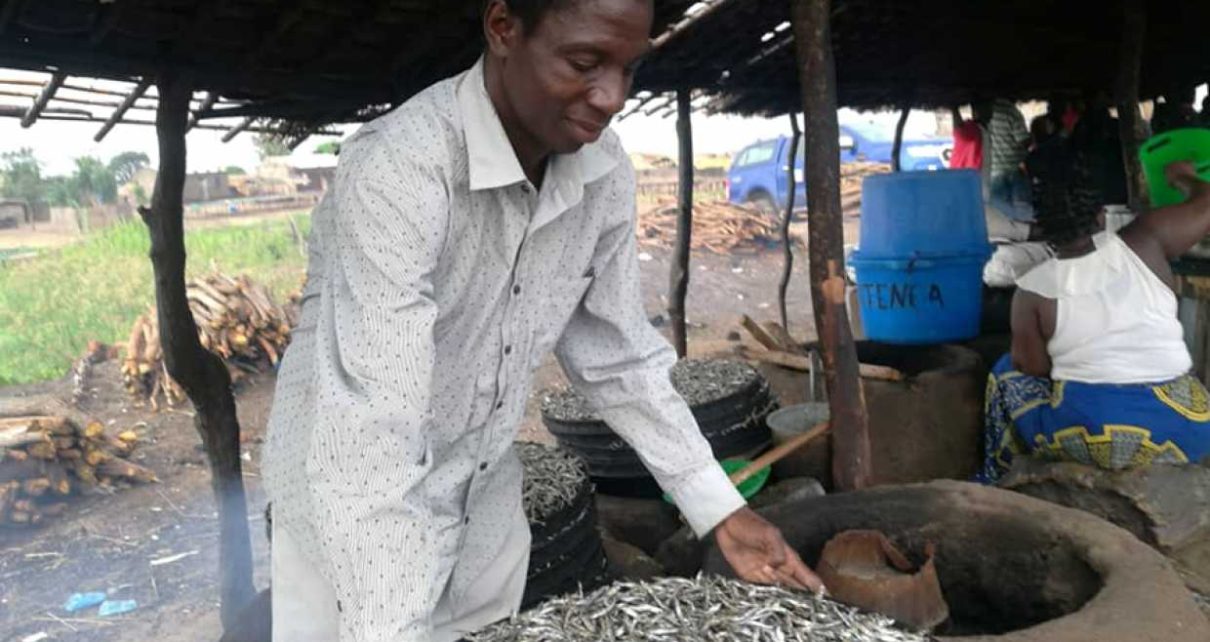
Necessity breeds invention, as the saying goes. This was exactly the case for Vincent Sande, a soft-spoken man who owns a self-built fish processing facility beneath a makeshift shade structure at Chiphole Beach, on the banks of Lake Malawi. Vincent’s site is one of the biggest and busiest at Chiphole, offering most of the major fish processing methods, including sun drying, smoking, parboiling and deep frying. He plays a key role in a supply chain that provides income and nutrition for countless Malawians.
Now, the processing site which used to consume a lot of fuel wood and produce thick smoke is home to stoves that use less firewood and emit less smoke. In this way, Sande is helping to slow down deforestation and smoky fumes that fuel global warming and air pollution.
Vincent first connected with Pact’s FISH project when a local FISH partner, Community Initiative for Self-Reliance, or CISER, offered him training in energy-saving fish processing technologies. Funded by USAID, FISH is helping the people of Malawi to rebuild ecosystems, improve biodiversity conservation and adapt to climate change. Through the training, which CISER offers at several busy beaches, Vincent learned to construct and use improved smoking kilns, mobile smoking kilns and energy-saving parboiling stoves.
With some skepticism, Vincent constructed two improved smoking kilns and two parboiling stoves, and he decided to pilot mobile smoking kilns. Seeing how well they performed using far less wood, Vincent was sold. Soon, he’d replaced all 20 of his traditional smoking kilns with improved ones, which look and work similarly but are shorter and have a smaller fire hole.
But instead of stopping there, Vincent was inspired to make further improvements based on his own experience using the new kilns and stoves. For example, because the parboiling stoves were built in an open space using mud, they would be rendered almost useless during Malawi’s rainy season, so Vincent worked on a mobile version made from sheet metal, which turned out to be even more efficient.
“The amount of fish that takes seven hours to smoke on the traditional smoking kiln is done in five hours when using the static parboiling stove and in four hours when using the mobile parboiling stove,” Vincent explains.
Vincent also learned from his customers that the initial mobile smoking kilns were too tall and too costly, and their rectangular top didn’t fit the type of smoking methods used. So he reduced the kiln’s height and changed the shape to circular. He also replaced the wooden plunks used as the kiln’s skeleton with used bicycle rims, which are cheap and easy to find. And when the fire holes on improved smoking kilns began erroding because they were too fragile, Vincent started fitting metal frames to the fire hole, and he banned the use of large pieces of firewood in his kilns, as these were found to be a key problem.
FISH and CISER are now embracing Vincent’s improvements and asked him to name them in recognition of his contributions. He chose to call them HaVi stoves – a combination of the first two letters of his wife Hawa’s name, and the first two letters of his own.
“I am hoping these modifications will increase the number of users,” Vincent says, “and eventually these technologies can save our forests.”
(Sources: The Nation Malawi, Thursday, 18 July 2019; https://www.pactworld.org/features/fish-processor-malawi-protects-environment-one-stove-time)