
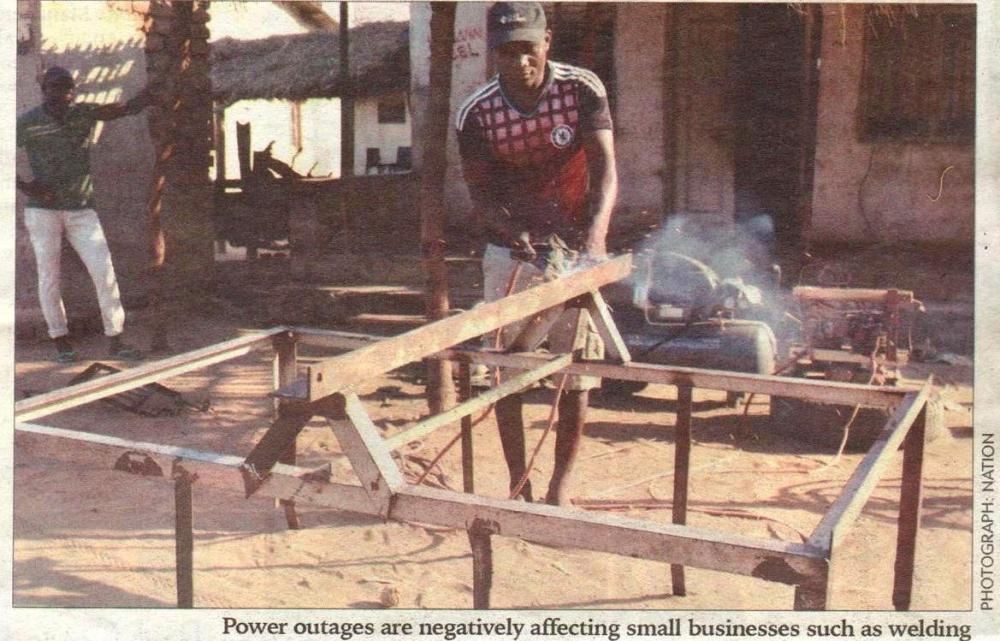
Prevailing and prolonged power outages in the country are negatively impacting on micro, small and medium enterprises (MSMEs) who have expressed concern that their businesses are almost dying.
Currently, the Electricity Generation Company (Egenco)—that sells power to the Electricity Supply Corporation of Malawi (Escom)—is only generating 160 megawatts (MW) of electricity against the average demand of 300MW, due to low water levels in the Shire River, which harbours 90 percent of Egenco’s hydro-electric power plants.
The reduced power production has seen Escom drawing a loadshedding schedule that is seeing customers going for between eight and 25 hours without power.
Random spot-checks with business owners around Lilongwe revealed sad effects of the power outages on this group of businesses, who cannot afford alternative sources of energy apart from charcoal and firewood for those in food businesses. But for those who run electronics, the struggle can only get worse.
One business owner operating a restaurant said her calculations showed that her food business has gone down by about 45 percent ever since the power problems started.
“During last year’s blackouts, we had to let go of two staff because we were not selling much. Being a restaurant, we have to rely on charcoal, but unfortunately there is a ban on that too. I think government has to think through these issues and how they are affecting us. The economy is collapsing while we watch,” she said.
Another business owner, who owns a salon, said she secured a generator which has, however, increased their operation costs which are being passed on to their customers.
“Normally, we make K80 000 day. But now we are making less. Turnout has also gone down because many people do not know we have a stand-by gen-set so in the event of a blackout they do not come” she said.
For welder Thomas Yonasi, this has not just affected his business but also time with his family at home.
“For example, if lights come back at 3pm, I have to stay late so that I cover a lot of work. My working hours have been greatly affected. My plea to you newspaper people is to let those responsible know that we work because we do not want to be beggars”.
Commenting on the developments, Small and Medium Enterprises Association (Smea) president James Chiutsi said the impact of the power outages is a definite knock to the economy and negative growth of the SME sector.
He said: “At a time when we are encouraging value addition to raw farm produce, it’s very retrogressive to experience massive power outages. No one can do meaningful value addition as most processes in production require use of machinery, we have members in oil production who need electric powered oil expellers, those in juice making who require electric pots, those in milling need electric mills, garages need all sorts of electric equipment.
“Such shrinkage definitely has huge social impact as SMEs who are the largest employers, are forced to lay off staff.”
Chiutsi added that more independent power producers need to be incentivised to generate power, and governing and operating policies should be simplified to ensure that more players feel attracted to the energy sector.
In his remarks, Malawi Confederation of Chambers and Commerce and Industry (MCCCI) head of public private dialogue Hope Chavula said businesses want to see a change in the power sector, which is key in day to day operations.
He said: “We see some promises like the Kammwamba [coal fired plant] and other power generation opportunities. We have also seen the energy sector open up for private operators but there are other issues that need to be dealt with, such as tariffs.”
A 2012 financial scoping survey of MSMEs showed that Malawi has about 760 000.